This piece is entirely my own experiences with a Private Obstetrician and Privately Practicing Midwife in Perth, Western Australia.
In Care Providers Part 1 I outlined the range of options that women have in Perth, WA, for who looks after them for pregnancy, birth and postpartum. However, I have learned so much in my motherhood journey just by listening to other people’s stories and personal experiences. This one is my story. Get comfy, it’s bloody long!
Pregnancy #1 with a Private Obstetrician
Antenatal Care with the OB
When I was pregnant with my first bub, almost all my friends had “gone private”, so I followed suit. I chose a private OB who was recommended and loved by a friend of mine. He was a mild-mannered and pleasant man who seemed quite supportive of my preferences for a physiological birth at the start of our relationship.
My pregnancy was straightforward, boring even, but in a good way. Because I was an easy case, appointments with my OB were short (10-15 minutes) and focused on checking my blood pressure and the baby’s growth.
In the meantime, I went about learning everything I needed (or thought I needed) to know about pregnancy, birth and breastfeeding by myself, with Google to guide me. I luckily stumbled upon some excellent resources, and prepared really well for birth.
When it was time to share my birth plan, I was nervous, as my OB and I hadn’t built much of a relationship. I had also gotten the impression, by this stage, that he had a more medicalised philosophy of birth than I had.

My plan was for a physiological birth, using hypnobirthing as a tool. My OB said most of my preferences were reasonable, but that we would have to deviate from them if “the baby had other plans”. He also told me that in his experience, hypnobirthing was more effective for second-time mothers than first-time mothers (it ended up being a wonderful tool, more so in my first birth than in my second!).
Despite knowing my preferences, and seeming quite supportive of them early on, the OB told me that I needed an induction not once, but twice, during my pregnancy. And I think it is safe to say that the baby’s plans had nothing to do with it.
The first time was related to a medication I was taking to prevent blood clots. I managed to dodge this induction by simply stopping the medication (I would not recommend doing that and it is not what I did in my second pregnancy- that’s a whole other post! In reality, taking the medication did not warrant an induction anyway!).
However, induction was raised again at 39 weeks. I was told that we needed to book an induction date because, if the baby didn’t come “in time”, there was an increased risk of stillbirth. I really didn’t want an induction, but the threat of my baby being stillborn was scary enough that I consented to booking a date.
I was not given any education on the risks of medical induction of labour- I was actually told there was no risk. I had to seek out the full and correct information myself. I was also not told the absolute risk of stillbirth, and I have since learnt that this risk remains very small, even at 42 weeks.
And, unfortunately, we didn’t go into spontaneous labor before that ominous date.
The Induction
33.3% of mothers in Western Australia had their labour induced in 2022, and I was one of them . But I was extremely lucky, I had relatively little intervention. Once labor started after the prostaglandin gel, things were good, and I didnt need synthetic oxytocin. This is one positive thing I can attribute to my continuity of care: the OB persisted with three doses of prostaglandin gel and gave me time to go into labour prior to taking further measures.
During most of my labour, I was in the care of a lovely midwife. I had never met her before, but she provided great support. As per hospital policy, I had vaginal exams and CTG monitoring throughout, which meant I couldn’t be as active as I wanted to, and I was pretty uncomfortable.
My OB arrived after I had started pushing. At this point I was feeling strong, and I was in that in-between-worlds-non-verbal stage. He offered me vacuum assistance because I had been “working hard for a long time”. A pretty poor reason to offer this, given the risks of instrumental birth, as well as my preferences! I refused the offer.
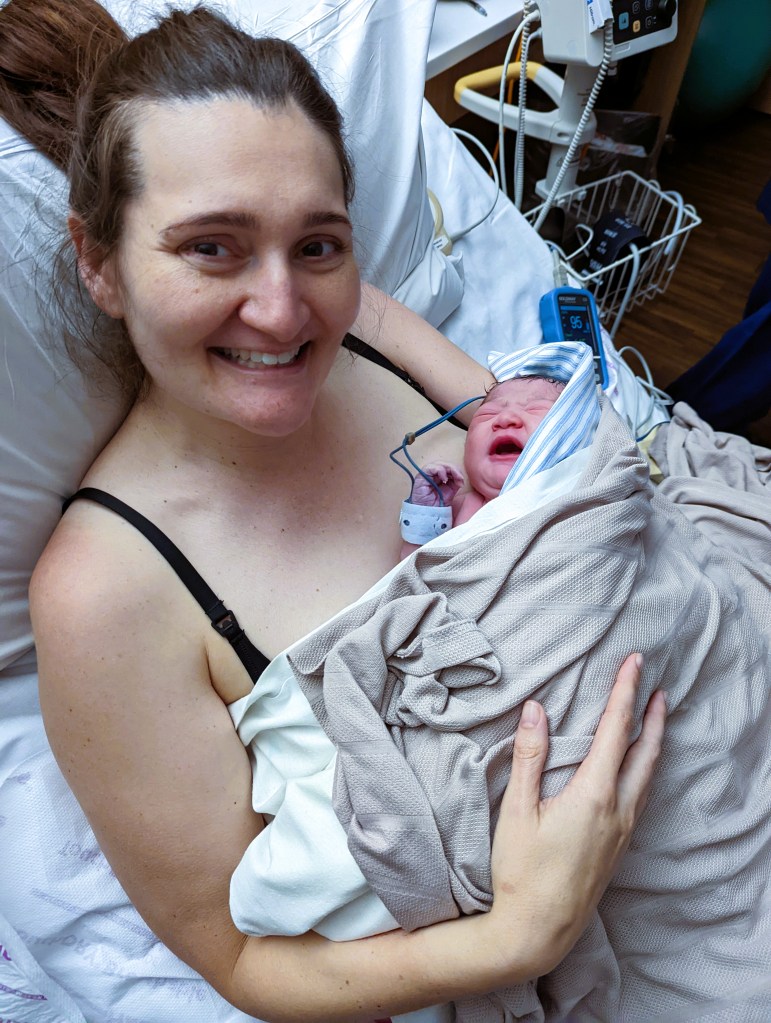
He held my leg for a bit and caught my baby as she emerged. She was perfect and I was feeling like a hero!
I had synthetic oxytocin injected into me for active management of placental delivery, because, again, this was hospital policy.
Postnatal “Care”
Postpartum care in hospital was fine, given staffing in hospitals is so stretched. Each time a midwife or nurse visited my room, it was someone different, who would put a different spin on how best to calm and breastfeed my baby. I didn’t mind the different advice, but I was growing weary of my boobs being handled by so many different people.
My OB came to visit me in my room at the hospital once, on the day after bub was born. He checked my notes and asked me how I was feeling.
In three days I was sent home. I had concerns that bub was crying too much and not getting enough food, but they told me that my milk had come in and bub was feeding well. They brushed us off as new parents and reassured us that “babies just cry a lot”.
But after 24 hours, bub was readmitted to hospital because, in fact, I was not producing much milk at all, and she was starving. My OB was not involved in any of this process- it’s not actually in their scope of practice.
The next time I saw my OB was when I was six weeks postpartum for my discharge appointment. At that appointment, I expressed a concern that I was quite sensitive about: sex had been really painful. He sort of brushed it off, and told me that sex was going to be uncomfortable until I stopped breastfeeding. He didn’t really give me any more information or any advice, and that was the end of our relationship.
Overall, I was disappointed with my care.
Antenatal appointments were unhelpful, and our birth philosophies were mismatched. Despite my desire for a natural birth and his knowledge of the cascade of intervention, he twice recommended induction, ultimately convincing me. He also offered instrumental delivery during labor, despite my written birth plan explicitly declining it, and with no medical justification. At the time I was luckily so full of adrenaline and I was “in the zone”, and I am thankful that I didn’t hear the implicit “you can’t do this” message.
Perhaps my biggest disappointment was that postpartum appointment. Had he taken my questions seriously, explained the physiology, or referred me to someone who could, he could have saved me months of anguish.
There were some real highlights from this first pregnancy and birth. I was so proud of myself and the experience was unlike anything in this world. But I wasn’t satisfied with my care.
However, I think it’s worth noting that, had I been more informed beforehand, I would have expected that type of care. An obstetrician can absolutely support physiological birth, but their training is actually in managing complex pregnancy and birth (for more information, see Care Providers: Part 1). I was a rather boring case, and so there was nothing really for him to do in his scope of practice, except look for problems that might pose risk. He was doing his job- it just wasn’t what I needed as a healthy, pregnant woman.
Pregnancy #2 with a Private Midwife
By my second pregnancy I had so much more experience and information about models of care and I knew exactly what I wanted. I wanted the gold standard: continuity of care with a known midwife. Homebirth was the dream, but my own midwife was an absolute necessity.
I chose a privately practicing midwife (PPM), as I didn’t qualify for the publicly funded programs. From the moment I spoke to her, I knew she was “the one”. She was an evidence-driven, pragmatic woman who understood that, most of the time, birth just works. She valued the vital role that birthing hormones play in aspects of pain management, breastfeeding initiation, and postnatal wellness.
She also knew that it required thought, planning and trust to create an environment conducive to a complication-free birth.
True Antenatal Care
Antenatal with my PPM could not have been more different to my first experience. These appointments were about my health, my wellbeing and about building a relationship. They weren’t quick, box-checking appointments. They were in my home (amazing when you have a toddler!), and were a minimum of 45 minutes long.
We discussed healthy blood sugar and iron levels, and she guided me through the process of blood-sugar monitoring and iron supplementation. She ordered lots of blood tests (more than in standard care) for me to keep an eye on my iron and haemoglobin levels.
She offered, but didn’t insist on, the screening tests for group-B strep and gestational diabetes, and ensured I was well-informed of all the risks and benefits to the screening and diagnosis of each condition.
A second midwife is required, by law, to be present during birth. I met her for a long antenatal appointment, and had the opportunity to get to know her and draw on her unique knowledge about breastfeeding.
As part of her legal requirements, my primary midwife also consulted with an OB from KEMH, where she had admitting rights. This OB referred me to a haematologist to discuss my blood clot risk and medication.
Going above and beyond, my midwife accompanied me to this appointment with a haematologist, so that she could be fully informed and so we could form a safe plan for birth.
So really, there was a team of people involved in my care, but one person who was overseeing the big picture.

We had very long conversations about birth and we did a lot of birth mapping. As we approached term, I felt confident that, whether we birthed at home or needed transfer to hospital, she would have my back, and would be able to give me the best possible clinical care.
She took every opportunity to build trust with my husband too, and he also felt confident that we were going to be looked after, even if we ended up in the system.
A Dream Birth
Whilst there is an element of luck involved, I was only able to have my dream birth because of who I chose to support me, where I chose to birth and because I had done the work.
I had a prelabour rupture of membranes and light meconium stained liquor. That is, my water broke before contractions started, and the baby had done a poo in utero. In the system, I knew this would have been met with panic, pressure to have routine vaginal exams, CTG monitoring and prophylactic antibiotics, and I would be on the clock, with them offering induction within 18 hours. These were interventions I had researched thoroughly, and wished to avoid them.
As always, my midwife laid out all the information: the physiology and the risks. She explained reasons why it might be good to go to hospital, and explained what the standard care would be once we got there. She then allowed me to make my own decision without coercion. And that made all the difference.
We decided to stay home.

My midwife supported my birth perfectly because she knew me so well. Because of all the work we had done together antenatally, I didn’t have to ask, learn, explain or argue anything during my labour.
I had a totally physiological birth, including placenta delivery.
My second birth story is a story for another time, but suffice to say it was exactly as I hoped it would be, and so much of that was because she and I both knew the plan, to the letter, and she knew me and my body.
Being Truly Held Postpartum
So, I was expecting a huge difference antenatally and during birth, that’s why I chose a PPM. What I did not expect was such an amazing standard of postnatal care.

The clinical follow up from my midwife was so thorough: I had daily visits for 5 days, and then weekly visits until I was six weeks postpartum. She did all the clinical checks that I would have had in hospital, for both me and our new baby. We talked a lot about breastfeeding, as this has always been my biggest challenge with my bubs. She was able to assist with this and she monitored bub’s jaundice.
Most importantly, perhaps, was that she provided amazing pastoral care.
I was held. I was held as I battled through feeding troubles, as I grappled with the hugeness of being a mother of two and as I recovered physically. It almost felt as though she was keeping me whole.
My recommendation: midwifery care, no question!
There is this belief in our medicalised society that an obstetrician is the absolute best person to get you through your pregnancy and birth because they are a doctor. The authoritative knowledge on all things health-related. But actually, no, not according to the research and not in my experience.
When it comes to physiological birth, and woman-empowered birth, midwives have the most extensive training, particularly midwives who have had to become endorsed and are privately practicing. These midwives have upskilled themselves to ensure that they are able to practice without the support of a hospital.
So, personally, I would recommend absolutely everybody choose continuity of care with a known midwife.
Even if you had complicating factors, and needed the care of an obstetrician, I would still recommend having continuity with a midwife, as you would still be able access the OBs in your midwife’s affiliated hospital.
Sadly, there is a financial aspect and issues with accessibility that complicates matters.
For my experience with a private OB, I paid $3,390 out-of-pocket for his and the hospital’s services. If you include the cost of upgrading to Gold hospital cover for 12 months, it comes to a total cost of about $4,700. With my PPM I spent a total of $5,500 out of pocket (no private cover required).
We could afford it, and were happy to pay. Others can’t.
If money is a hurdle, there are publicly funded programs that I would recommend you look into: CMP/MGP at your local hospital, birthing in the Birth Centres, or going through a semi-private program like Western Obstetrics.
But even with those options, only 70% of women in W.A. are currently able to access continuity programs with a known midwife.

ACTION IS NEEDED
If you are a Councillor, MP, or involved in any kind of decision making in a hospital- PLEASE read Care Providers: Part 1. Continuity of care with midwife is shown to be less expensive for the hospital than fragmented care, and results in far better outcomes for both mum and bub.
Every woman should have access to continuity, and should be given choice. For me, it shaped not just my experiences of pregnancy of birth, but also my family’s health and well-being as we enter the next chapter of our lives.
Follow Me & Subscribe
A WordPress.com site.

 Perth Birth Nerd
Leave a reply to Midwifery Continuity of Care: Solid Gold – Perth Birth Nerd Cancel reply