The placenta and umbilical cord are some of my favourite topics to nerd-out about. Imagine: a temporary organ that performs so many life support functions for our babies, and it’s grown in just a few weeks, with all of its amazing complexity?! Too cool! Let’s go on a journey to discover their anatomy, functions, and some awfully funky facts.

Placentation
The placenta starts to grow EARLY. It grows from the blastocyst, which is the clump of cells that forms around day 6 after fertilisation. Even before the blastocyst implants in the endometrium (uterus wall), the outer layer, called the trophoblast, starts separating and forming what will soon be the placenta.
From this early stage, the placenta continues to grow, and is considered a fully developed and functional organ just 9 weeks later (12 weeks gestation, 10 weeks after ferlisation).
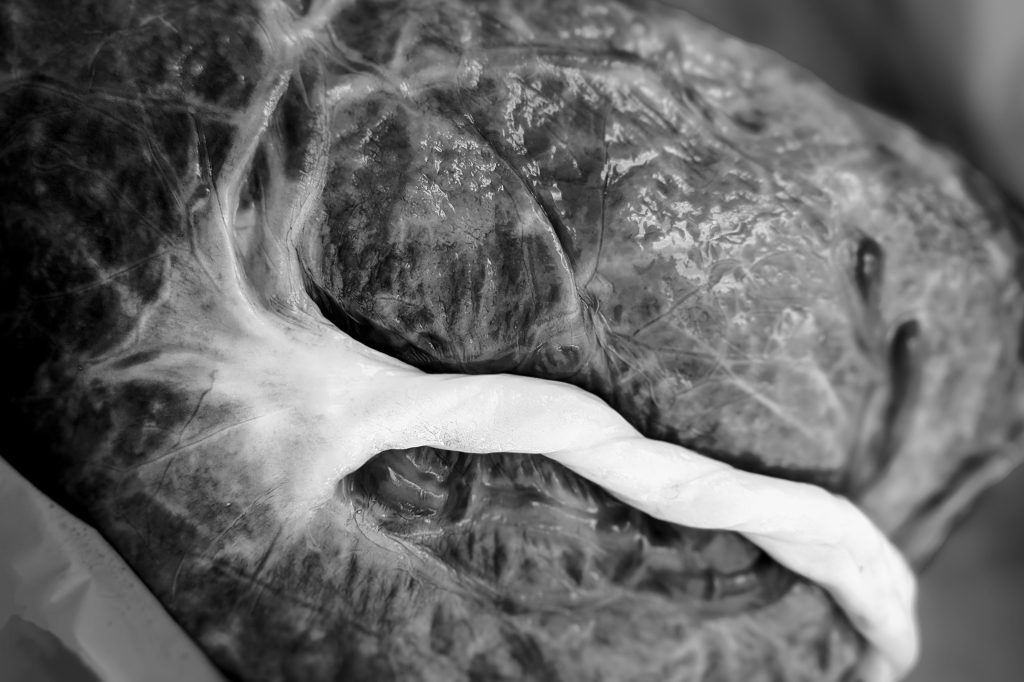
Basic Anatomy
Most of the placenta is actually formed from the cells of the embryo, so it shares your baby’s DNA and is considered the fetus’s organ. There are 3 main parts of the baby’s placenta: the amnion, the chorion and the umbilical cord. However, there is a section made from the mother’s cells, on the outside, called the decidua.
Imagine that- one organ, containing two people’s unique DNA!
The decidua is the modified endometrium (yes, this is why we’ve been getting periods all the years, for this decidua!). It contains the maternal blood vessels, which come from the uterine wall itself. These vessels bring all the good stuff into the placenta, and takes out the waste.
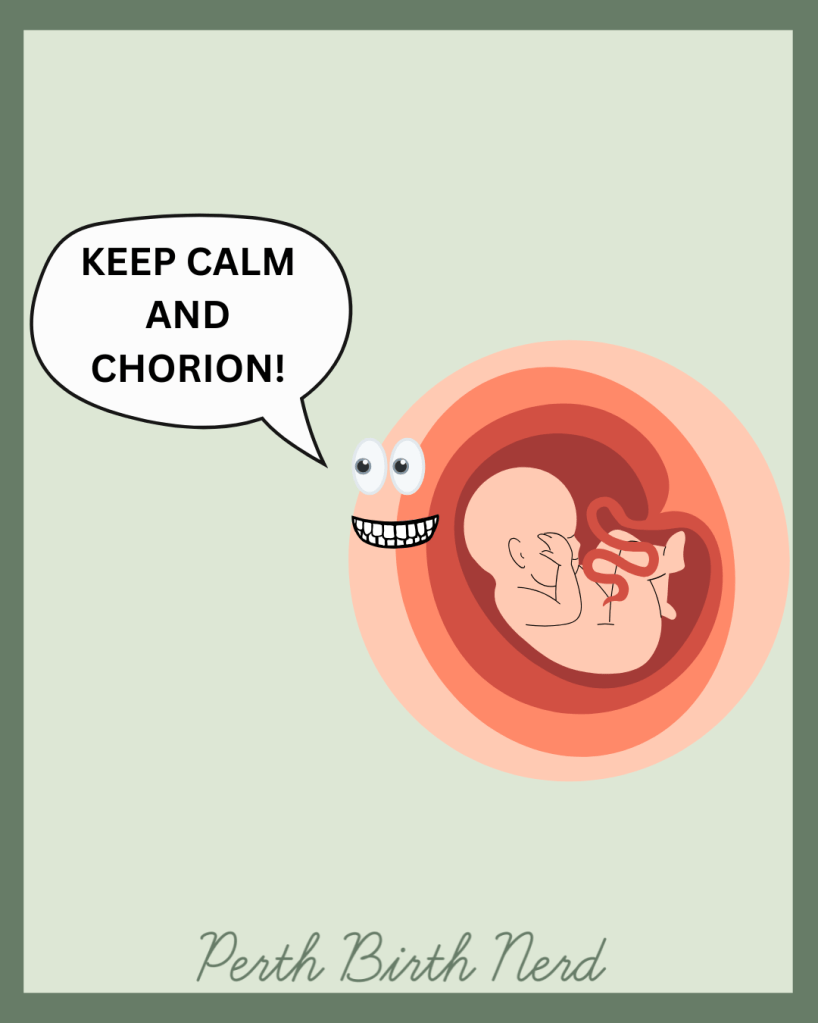
Under that layer is the chorion, a thick membrane. Here, the nutrients and oxygen diffuse into the baby’s blood supply, and waste diffuse out. The blood vessels in the chorion take the good stuff to the vessels in the umbilical cord, which the nutrient/waste highway straight to bub.
The amnion is a thinner membrane and sits on the baby-side of the placenta, and has a shiny appearance.

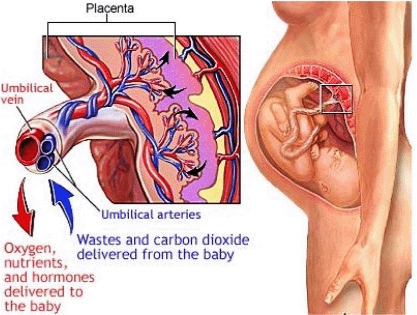
The umbilical cord has 2 arteries, which carry waste and carbon dioxide back to the mother, and one vein, which carries nutrients and oxygen to the fetus. These blood vessels kind of spiral around each other through the cord.
It’s imperative that these vessels do not get squished, so placental mammals have evolved something pretty cool to protect them: Wharton’s Jelly. Wharton’s Jelly is a gelatinous substance that cushions the vessels, protecting them from compression and also torsion.
I’m Very Busy and Important
Once fully formed, the placenta has many functions. The main ones include:
Blood Supply. At full term, a woman’s blood flow to the placenta is about 600–700 ml/minute. Nutrients and oxygen nourish the placenta and cross into the fetal blood supply. Conversely, the placenta allows waste and carbon dioxide to cross from fetal blood into maternal blood so that the woman can excrete it. The two blood supplies never actually come into contact with each other.
The average sized baby will have blood flow through its cord of 230mL/minute at full term.
Endocrine Function. The Placenta produces a variety of hormones. Human chorionic gonadotrophin is produced from the earliest cells, signalling to the woman’s body that she is pregnant. Other hormones are produced to prepare the mother’s body for pregnancy, including placental growth factor and human chorionic somatomammotropin (try saying that five times fast!!).
Immune. The placenta protects the baby against infection, with many white blood cells in the walls of the decidua and chorionic villi.
Makin’ it Moist. The amnion produces amniotic fluid, keeping the baby cushioned and protected.
Some Extra-Cool Funky Facts
1. A fetus can get puffed out! In utero, babies don’t need to breathe, they get all their oxygen through their umbilical cords. However, breathing motions start early in pregnancy. What is funny though, is that when a mother has high carbon dioxide in her blood, the baby does these breathing motions more rapidly- just like you do when you’ve been out for a run!
2. As long as a piece of string. A full term umbilical cord averages 55cm in length, but this varies significantly. The lower 5% of cords are less than 35cm and the higher 5% are more than 80cm!
3. Wait ’til white! Optimal cord management, sometimes referred to as “delayed” cord clamping, has many health benefits. In full term babies, it increases the levels of red blood cells, iron and ferritin that the baby, even at 6 months of age. In preterm infants, the benefits are even more significant, lowering some of the risks associated with preterm birth, such as infections and even mortality.
4. The power of a cuddle is not just emotional- it’s physical! After the birth of a baby, the placenta needs to be born (sometimes referred to as the “third stage of labour”). Skin-to-skin contact with the baby, and the baby’s first attempts at attachment at the breast increase the amounts of the hormone oxytocin in the mother (which are at peak levels right after birth). This helps facilitate uterine contractions required to birth the placenta safely.

I hope you enjoyed this very basic look into one of my favourite topics. If you are currently expecting, and interested in topics like physiological placenta birth or optimal cord management, drop me a line and I’ll direct you to some awesome resources. And don’t forget to ask your midwife for a “placenta tour” after birth. Haha… after birth. I didn’t even try that time.
References
Buckley, S.J., (2010). Leaving Well Alone: A Natural Approach to the Third Stage of labour. https://sarahbuckley.com/leaving-well-alone-a-natural-approach-to-the-third-stage-of-labour/
Ferreira, S. (2023). Placenta. Kenhub. https://www.kenhub.com/en/library/anatomy/placenta-en
Herrick EJ, Bordoni B.(Updated 2023). Embryology, Placenta. Treasure Island (FL): StatPearls Publishing; 2025. https://www.ncbi.nlm.nih.gov/books/NBK551634/
Kapila V, Chaudhry K. (Updated 2023). Physiology, Placenta.Treasure Island (FL): StatPearls Publishing; 2025 Jan. https://www.ncbi.nlm.nih.gov/books/NBK538332/#:~:text=Development,disappears%20from%20the%20chorionic%20villi.
The Editors of Encyclopaedia Britannica (2018). Amnion. Encyclopedia Britannica. https://www.britannica.com/science/amnion
Wang Y, Zhao S. (2010). Vascular Biology of the Placenta. San Rafael (CA): Morgan & Claypool Life Sciences. Chapter 2, Placental Blood. Circulation.https://www.ncbi.nlm.nih.gov/books/NBK53254/
Whittington Health NHS Trust. (2023). Optimal Cord Management. Whittington Hospital. www.whittington.nhs.uk
 Perth Birth Nerd
Leave a comment